Searching for full hookup RV parks is the fastest way to find a campground where your rig can plug in, fill up and drain without moving. But "full hookup" on a listing does not tell you everything: an RV site can offer 30 amp or 50 amp electric, the sewer connection can sit on the wrong side of your rig, and campground water pressure can be high enough to damage your plumbing. This guide explains what full hookups include, the real difference between 30 amp vs 50 amp service, and what to check before you book an RV site, so the park you pick actually fits your rig.
Quick Takeaways
Key Insight | Explanation |
|---|---|
Full hookup means electric, water and sewer at your site | Partial hookups usually mean electric and water only, so you drain your tanks at a shared dump station. |
50 amp service carries more than three times the power of 30 amp | A 30 amp connection gives about 3,600 watts; a 50 amp connection gives about 12,000 watts across two 120-volt legs. |
Your rig's plug decides what you need, not the other way round | A 30 amp rig can use a 50 amp pedestal with an adapter, and a 50 amp rig can run on 30 amp with an adapter, but only on a reduced load. |
Protect the rig before you plug in | A surge protector or electrical management system and a water pressure regulator are cheap insurance against bad pedestals and high campground water pressure. |
Ask where the hookups sit on the site | Sewer and power are usually on the driver's side. A back-in site laid out for the other side can leave your hoses and cord short. |
What "Full Hookup" Means at an RV Park
A full hookup RV site has three connections waiting at the pad: an electrical pedestal, a fresh water spigot and a sewer inlet. With all three, you can run the air conditioner, take long showers and empty your black and gray tanks without ever leaving the site. That is why full hookup RV parks are the default choice for families who travel full time, anyone staying a week or longer, and anyone camping in heat that needs the AC running all day.
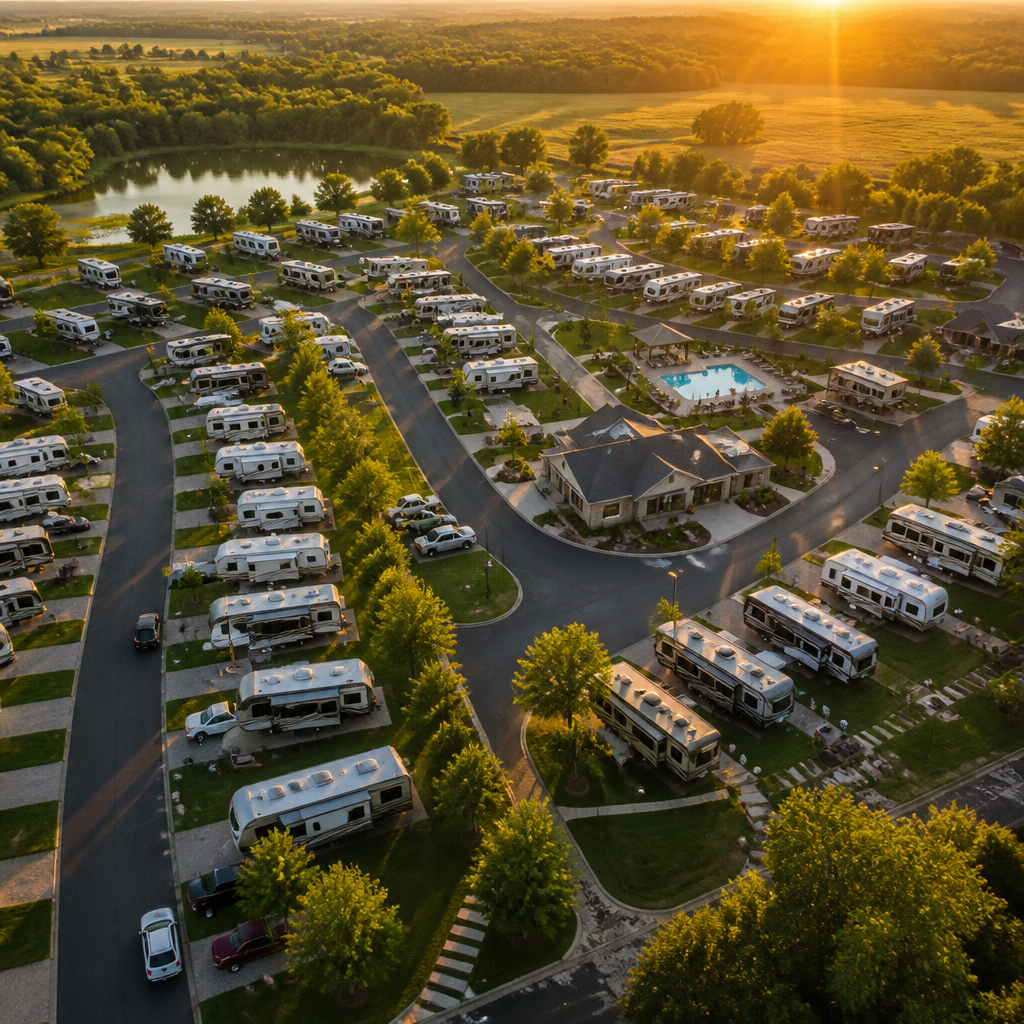
Some campgrounds add cable TV or a Wi-Fi connection and still call it "full hookup", and a few say "full hookup" when the sewer is really a shared dump station a short walk away. If sewer at the site matters to you, ask the park directly when you book.
30 Amp vs 50 Amp: The Real Difference
The difference between 30 amp and 50 amp RV service is much bigger than the numbers suggest.
30 amp service is a single 120-volt line. At 30 amps that is about 3,600 watts in total, enough for one air conditioner plus a few small appliances. Run the AC, the microwave and a hair dryer together and you will likely trip the breaker. Its plug has three prongs.
50 amp service brings two separate 120-volt lines, each rated at 50 amps. That is about 12,000 watts, enough for two air conditioners, a residential fridge, a washer-dryer and the rest of a large coach running at the same time. Its plug has four prongs.
Most travel trailers, smaller fifth wheels and Class C motorhomes are built for 30 amp. Larger fifth wheels, toy haulers and Class A motorhomes with two or more AC units are usually built for 50 amp. Check the plug on your shore power cord: the prong count tells you which one your RV uses.
Using Adapters ("Dogbones")
A short adapter, often called a dogbone, lets you plug into a pedestal that does not match your cord. A 30 amp RV on a 50 amp pedestal works fine; you still only get 30 amps, but you have access to more RV sites. A 50 amp RV on a 30 amp pedestal also works, but you are limited to about 3,600 watts, so run one AC at a time and avoid stacking big loads. Many RV parks list 20, 30 and 50 amp outlets on each pedestal, so ask what is available if your rig needs 50.
Full Hookups vs Partial Hookups vs Dry Camping
Site type | What you get | Best for |
|---|---|---|
Full hookup | Electric, water and sewer at the site | Long stays, full-time families, hot weather, big rigs |
Partial hookup (water and electric) | Electric and water; tanks emptied at a dump station | Weekend trips and stays of a few days |
Electric only | Power at the site; fill water and dump elsewhere | Many state park campgrounds and short stops |
Dry camping / boondocking | No hookups at all | Free or cheap stays on public land, self-contained rigs |
Full hookup sites usually cost more a night than partial hookup sites at the same campground, so it is worth matching the site to your trip. If you are planning a few nights off-grid between full hookup stays, our guide to RV boondocking and dry camping covers power, water and tank management without hookups.
Hooking Up at a Full Hookup Site, Step by Step
Check the pedestal first. Turn its breakers off, then plug in your surge protector or electrical management system and let it test the power before you connect the RV.
Connect shore power. Plug your cord into the protector, then turn the pedestal breaker on.
Connect water through a regulator. Put a water pressure regulator on the spigot and use a drinking-water-safe hose. Campground pressure varies a lot, and a regulator keeps it in a range your plumbing is built for.
Connect the sewer hose. Seal the hose into the sewer inlet with a fitting or a weight, and give it a steady downhill slope.
Keep the black valve closed. Leave the black tank valve shut until the tank is at least two-thirds full, then dump black first and gray second, so the gray water rinses the hose. Leaving it open lets liquids drain and solids stay behind.
What to Check Before You Book an RV Site
Amperage: Confirm the site has 50 amp service if your rig needs it. Some parks only have a limited number of 50 amp sites.
Site length and type: Check that the pad fits your rig and tow vehicle, and ask for a pull-through site if you would rather not back in. Look for parks marked big-rig friendly if you drive a 40-foot coach.
Hookup placement: Ask how far the sewer and pedestal are from the pad, and carry a hose and cord long enough to reach.
Wi-Fi and cell signal: If you work from the road, ask whether the Wi-Fi reaches the sites or only the office.
Family and pet rules: Check pet limits, breed rules and quiet hours, and whether there is a pool, laundry or playground for the kids.
Find Full Hookup RV Parks by State
Your Drive lists RV parks, campgrounds and overnight parking across the US for families who live and travel on the road. Each listing shows the amenities we know about, including full hookups, Wi-Fi, laundry, dump stations and big-rig access. Start with the RV parks directory by state, or jump straight to a popular state:
RV parks in Arizona: winter warmth and desert full hookup resorts.
RV parks in Florida: long-stay parks along both coasts.
RV parks in Texas: big-rig friendly parks along the interstates.
RV parks in California: coast, desert and national park gateways.
RV parks in Colorado: mountain campgrounds with hookups.
Want to know how we build the directory? Read how to use the RV parks directory. You can also drive the road to see every park as a roadside sign.
Frequently Asked Questions
What does full hookup mean for RV camping?
Full hookup means the RV site has its own electrical, fresh water and sewer connections. You can use your RV like a house without filling or dumping tanks at a separate station.
Can I plug a 30 amp RV into a 50 amp outlet?
Yes, with a 50-to-30 amp adapter. Your RV still only draws up to 30 amps, which is safe. Many pedestals also have a 30 amp outlet, so you may not need the adapter at all.
Can a 50 amp RV run on 30 amp service?
Yes, with a 30-to-50 amp adapter, but you only get about 3,600 watts. Run one air conditioner at a time and avoid using the microwave, water heater and other big loads together.
Are full hookup RV parks more expensive?
Usually, yes. At most campgrounds a full hookup site costs more than a water-and-electric site, and 50 amp sites can cost more than 30 amp. Weekly and monthly rates often bring the nightly cost down for long stays.
How do I find RV parks with full hookups near me?
Browse the Your Drive RV parks directory by state and look for "Full hookups" in each listing's amenities, then call or check the park's website to confirm 30 or 50 amp service and availability for your dates.